Transfer of a 20 y.o. Patient from Zilina, Slovakia to Bogota, Colombia
Home, at last!
On January 28, we performed a secondary transfer of a 20-year-old male patient from Zilina, Slovakia to Bogota, Colombia.
Status Report:
A 20 years old patient with no history of illness who was studying at university in the city of Zilinia, Slovakia. At the end of October, he was admitted to the hospital Fakultna nemocnica s poliklinikou Žilina – Parkovisko.
Initially, due to neurological deterioration followed by coma, the initial CT scan revealed HIPE (spontaneous intraparenchymal hematoma) that required emergent neurosurgical drainage.
Later, in the neurocritical unit, he required percutaneous tracheostomy due to prolonged invasive mechanical ventilation and infectious intercurrences.
When Aeromedical and Marine received the transfer request, he was admitted to the chronic care unit, without ventilatory support, but he did have quadriparesis and mixed aphasia.
Patiently vigilant, at times he seemed connected to the environment. Hemodynamically stable without the need for vasoactive medication. At the respiratory level, good bilateral air intake, with abundant secretions that were difficult to manage and required bronchofibroscopy due to lobar atelectasis. For his feeding, a gastric button with a tube and continuous enteral nutrition by pump were implanted.
He had episodes of muscle spasms at the distal level of the extremities that required analgesic and spasmolytic medication, as well as the use of corrective splints to prevent joint stiffness.
Preparing for the move
AEROMEDICAL AND MARINE received the transfer request at the beginning of January. The mother contacted us directly asking for help and advice for her son’s return to Colombia.
At that point, the logistical and administrative team got to work designing the repatriation of the boy.
It always works in the same way:
First, all the patient’s medical reports are requested to know what happened and its evolution and, above all, the patient’s updated situation.
At the same time, we began to explore and map out what would be the best route for the return, which airlines could do it and what ground support teams we would need.
During this process, we got to know his case, a fact that made us get involved in a more personal way in helping his repatriation. We echoed the campaigns that his parents and family promoted on social networks to be able to return him home. We talked and informed the parents, explaining all the steps we were taking to be able to repatriate their child, so that they did not despair, even if it seemed that everything was going slowly, we looked for security in our procedures, not to leave any loose ends and that on the day of the return home there were no problems and everything was ready.
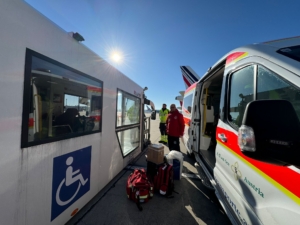
The design of the repatriation was not easy. On a medical level, the hospital provided us with the patient medical history and updated information. He needed to travel lying on a stretcher and assisted by a medical team specialized in intensive care and all the equipment that entails. In addition, to make it affordable, you had to fly on a commercial airliner with the difficulty that you had to make stopovers and change planes to your destination. Few airlines offer this stretcher service and medicalization capability on their planes. In this case, Air France provides the service, but on specific days, as the conditioning of the cabin space to convert it into a medical area is not easy. Thanks to our travel manager CAPIEVE who took care of all the air booking arrangements, the medical team was able to focus on planning assistance during the trip.
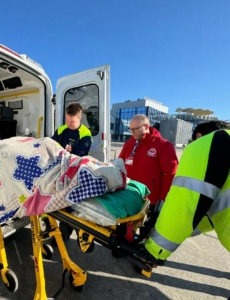
Also, the Government of Colombia, through its secretariat of the presidency and the embassy in Vienna, helped to manage and support the boy and the family for their return home.
The whole planning process took us 20 days, until the dates set for the patient repatriation were set for January 28 and 29, 2024.
In the end, the repatriation plan went like this:
The patient is a 20-year-old HIPE sequelae patient with quadriparesis and mixed aphasia, recently weaned from invasive mechanical ventilation. He was admitted to the hospital in Zilina, accompanied by his parents and university environment.
The initial team was going to consist of 4 people, 2 doctors and 2 nurses, who would work together to adapt and accommodate him for the transfer at origin.
Then it would be two of them who would make the entire transfer to Colombia.
The air route would be a first flight from Vienna to Paris and from there to Bogotá. This meant that we had to use a ground ambulance from Zilina hospital in Slovakia to Vienna airport in Austria and a taxi for the parents. Previously, everyone’s exit visas had to be processed. In addition, the medical team was divided here, and they would carry out the plane transfer alone with the ambulance team that was waiting for them in Paris. On this second plane, they had to recondition the patient and the equipment for a journey of more than 10 hours.
Once in Bogotá, another team would take care of the transfer to the hospital of admission.
From the AEROMEDICAL AND MARINE ground team, an instant messaging group and communication channels are created with the different suppliers to be able to monitor the transfer in real time.
On the 28th we all met at the offices of AEROMEDICAL AND MARINE, we checked the electromedical material, as well as medical and disposable supplies in the face of the different eventualities that arose during the transfer, since it presented different challenges, ground part in ambulance and two transfers in commercial flight. In addition to the distance to be covered in an estimated time of 24–26 hours of transfer.
Once the equipment has been checked and the whole work plan has been reviewed again, we leave for the airport and travel to Vienna first and by road from there to Zilina.
Transfer
On January 29 at 4 am UTC +1, we arrived at the hospital where we began the transfer, the assessment and the information collected at the time coincided with our travel strategy and patient requirements. We did a pre-transfer briefing again, in which we included the hospital team that was caring for him. They gave us the latest guidelines on the patient condition, treatment, and care. Here the language difficulty came together, but between Spanish, English and an online translator we were able to develop the briefing satisfactorily, and we all knew the action plan.
Before starting, we explain to the patient and his parents everything that awaits us and that we will perform a very superficial sedation to better tolerate the trip, especially to treat the pain that caused the spasticity of his neurological sequelae and that, finally, we return home. We wanted them to not only trust us, but also understand everything we did, collaborate and be part of the team that brought the boy home.
We explain the travel itinerary and how we will act in the event of any inconvenience that arises, since they will accompany us until the end.
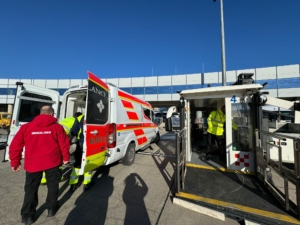
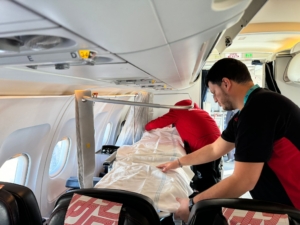
Our journey began with the ground ambulance that took us approximately 300 km from the city of Zilinia in Slovakia to the airport of Vienna, Austria, where the commercial airliner AIR FRANCE was waiting for us with the sector designated to us, equipped with stretcher and medical supplies, to which we added our medical equipment.
Once on the aircraft, we did a quick joint briefing of crew and aeromedical personnel, explained to the ambulance and runway personnel the steps to follow for the transfer and established an action plan.
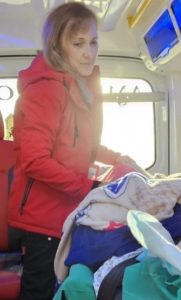
Once on the plane, we accommodate the patient and condition all the devices, vascular and respiratory accesses, we replace and fix them to the available space. We especially check the bladder and nasogastric tube, as it can cause problems with pressurization changes.
For the transfer, we instituted prophylactic anticoagulation and continued with the analgesic and antibiotic therapy regimen according to the issuing hospital scheme.
After reaching 35000 ft, the patient remained stable without incident during the flight to the second stop. Paris, France. Where we make the transfer with change of aircraft.
We made the transfer to the ambulance that took us to the AIR FRANCE commercial plane that will fly from Paris to Bogota. Always with a previous briefing with the new participants and checking that everything was going well for the boy.
Once on the plane, the crew was also waiting for us with a large area designated for us, with medical supplies and curtains that separated us from the rest of the passengers. With a quick briefing of crew and aeromedical personnel, we explain to the ambulance and track personnel the steps to follow for the transfer. We established an action plan. We finally got on the road again without incident.
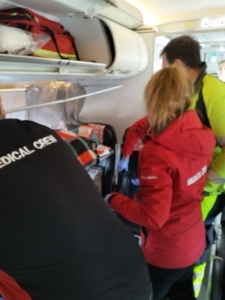
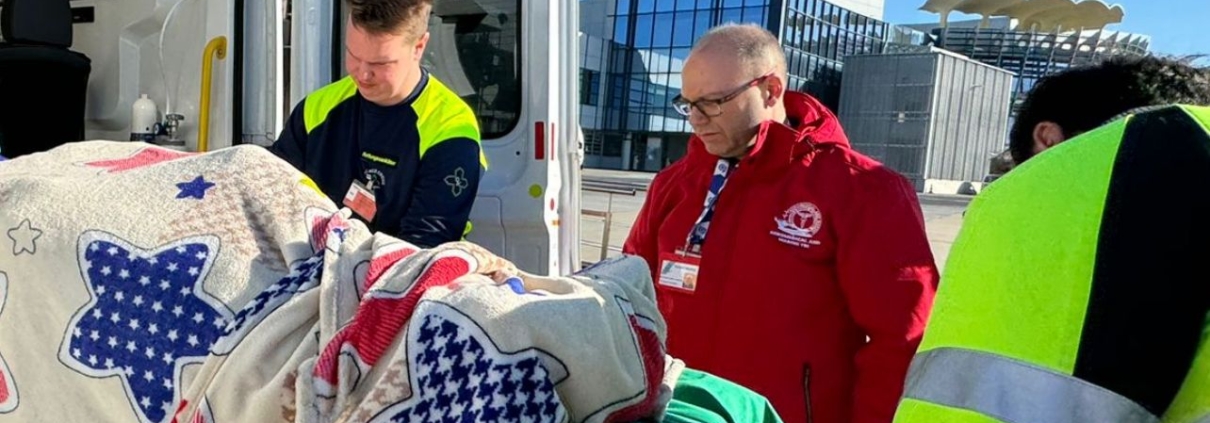
After 26 hours. After the trip, we arrived in Bogota. We held briefings with airport medical staff, ambulance medical staff who would take the patient to the receiving hospital, and airport firefighters. The difficulty arose that the door through which the patient had to go down could not be used, so with fire and track personnel we established a change of strategy for the transfer through the passenger boarding gate after the descent of all the commercial passengers.
With no medical incidents and except for the small problem of the last disembarkation, the boy arrived at the hospital in Bogotá in the company of his family
Finally, at home!
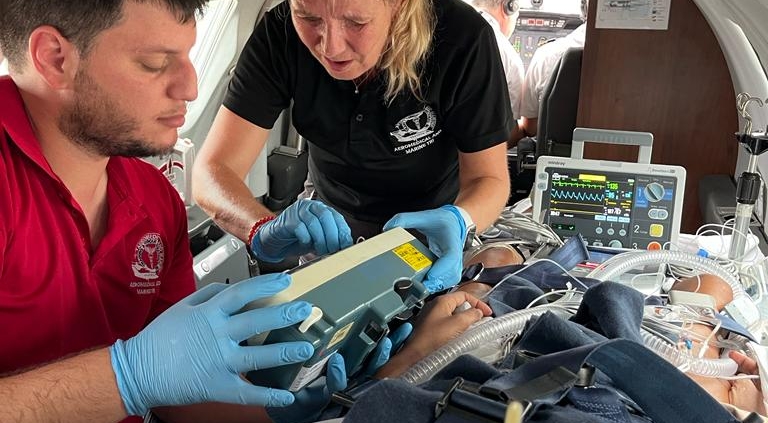
Last chance for a critical patient
Barcelona, October 4, 2023
Dr FERNANDO JUAN GERBER
On September 2023, we carried out a secondary transfer of a 45-year-old patient from Senegal to Spain.
Status report
The patient was a patient with a history of pleural tuberculosis in 2016 and COVID-19 lung disease in June 2023.
Currently, the patient was admitted to the intensive care unit in Senegal with a requirement for invasive mechanical ventilation since September 9 with a diagnosis of diffuse lung disease without associated organ failure.
Preparation for the transfer
The collection of information was quite difficult, the language barrier, the disparity of pathophysiological concepts for the diagnosis and treatment of the pathology to be treated and the availability of resources at the destination, made it difficult to diagnose the patient’s real situation.
With the information collected, we defined that the patient was a 45-year-old patient with a history of acute lung disease and who was currently experiencing adult respiratory distress syndrome with persistent hypoxemia and hypercapnea, associated with pneumothorax of the right lung field without associated organ failures.
The day before departure, at the Aeromedical and Marine TRI facilities, we held a mission briefing based on the information collected at the time. Transfer decision, modality, requirements, etc. a check of electromedicine and supplies, including verification via checklist of medication and consumables as well as testing of electronic equipment, batteries and connections to an electrical source.
Already at the airport we transfer electromedicine and supplies to the aircraft, we check respirator connections and electrical connectivity to the aircraft stretcher.
Crew briefing
Pilots present flight plan, schedules, flight profile, safety measures.
Aeromedical personnel raised the secondary transfer situation, aircraft requirements for the transfer, updating information on the patient’s global situation and the family and hospital environment.
We arrived at the airport in Senegal without incident. The transfer picked us up on time and took us to the hospital where the patient was for an assessment prior to the transfer.
Once there we prepared to enter the intensive care unit, we corroborated the information previously received but the severity of the situation was underestimated by the unit’s treating staff.
This was a 45-year-old patient with a history of acute lung disease who was currently experiencing adult respiratory distress syndrome with refractory hypoxemia and a large bronchopleural fistula.
Transfer
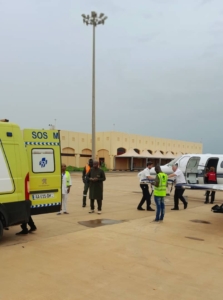
On October 23, early in the morning, we met on the tarmac with the ambulance that brought us the patient from the ICU. The patient was in the same condition as the night before. The ambulance doctor told us that the patient spent the entire night awake, struggling with mechanical ventilation and having an oxygenation crisis.
Before boarding the aircraft, we explained to the patient that we would put him to sleep and that we were going to travel by plane to another country to help resolve his condition.
We did a quick briefing of the crew, pilots and aeromedical personnel, we explained to the ambulance and runway personnel the steps to follow for the transfer. We established an action plan.
We performed deep sedation and neuromuscular blockade on the patient, then we transferred electromedicine. We optimized mechanical ventilation and quickly obtained respiratory improvement.
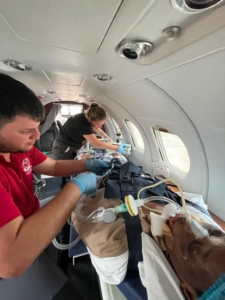
Once on the plane we conditioned all the devices, vascular access, respiratory orotracheal tube and pleural drainage, we replaced fixations, we sanitized the oral cavity that had large pressure ulcers from the oral device. Bladder and nasogastric tube.
During the transfer we reinforced prophylactic anticoagulation and stimulate a diuretic rhythm. We reinforced corticotherapy.
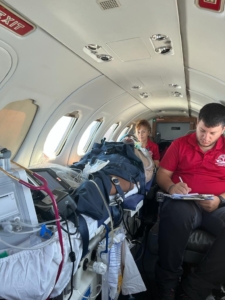 Finally, after 7 hours 50 minutes, requiring a stopover in the Canary Islands to supply fuel and oxygen, we arrived in Madrid. We transferred her to an ambulance that took her to the ICU at her destination without incident.
Final diagnosis
1) ARDS with refractory hypoxemia
2) Bronchopleural fistula
Dr FERNANDO JUAN GERBER
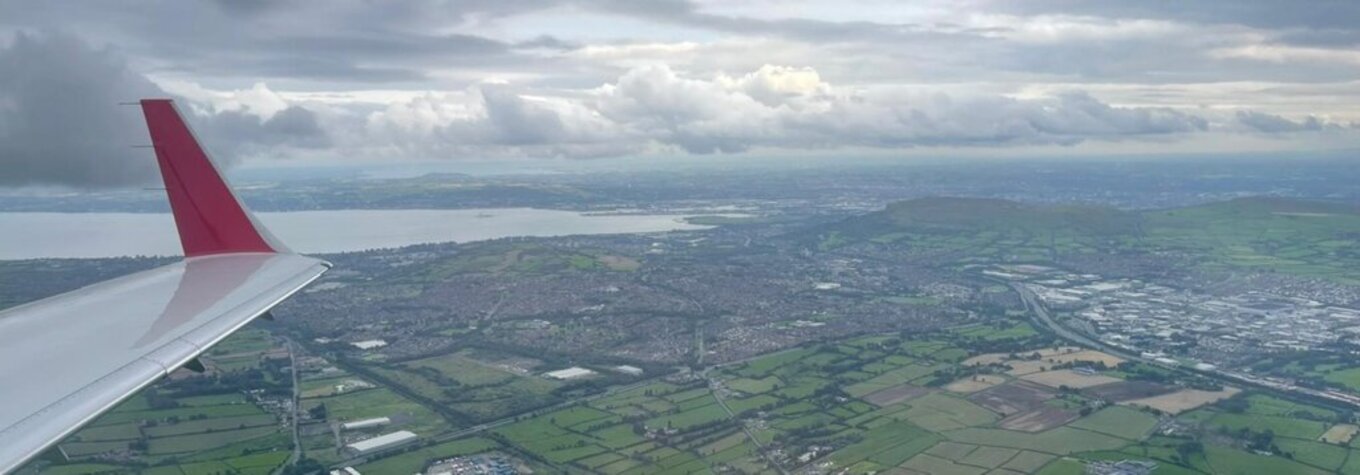
Successful Repatriation to Northern Ireland
Hello again, dear friends,
from Aeromedical and Marine, we feel very proud and satisfied that Dr Monica Fortea has carried out a new successful repatriation collaborating with 247 Aviation. We share through the blog the comments of the Fallon family about the operation to return to Northern Ireland
We are very happy to have been part of the repatriation process for Chris Faloon, who suffered an accident during his holidays in Portugal.
Chris is already in his city, after the family started a collection process to start the repatriation.
We wish them a speedy recovery and share their story on our blog as one more case of a successful repatriation.
Here you can see the news published by the press about the case:
Here are the family’s comments through a publication on the social network Facebook. This is the transcript of the message:
Next stop, Northern Ireland!! Don’t think anyone has ever been so happy to get home from their holidays!
This wouldn’t have been possible without the support from everyone back home and with saying that we would once again like to thank each and every person with our whole hearts for your help! ❤️
Many Thanks,
Chris and the Faloon Family
In this LINK you can see the Facebook post
Thanks to you Chris and family.
Aeromedical and Marine TRI, Team
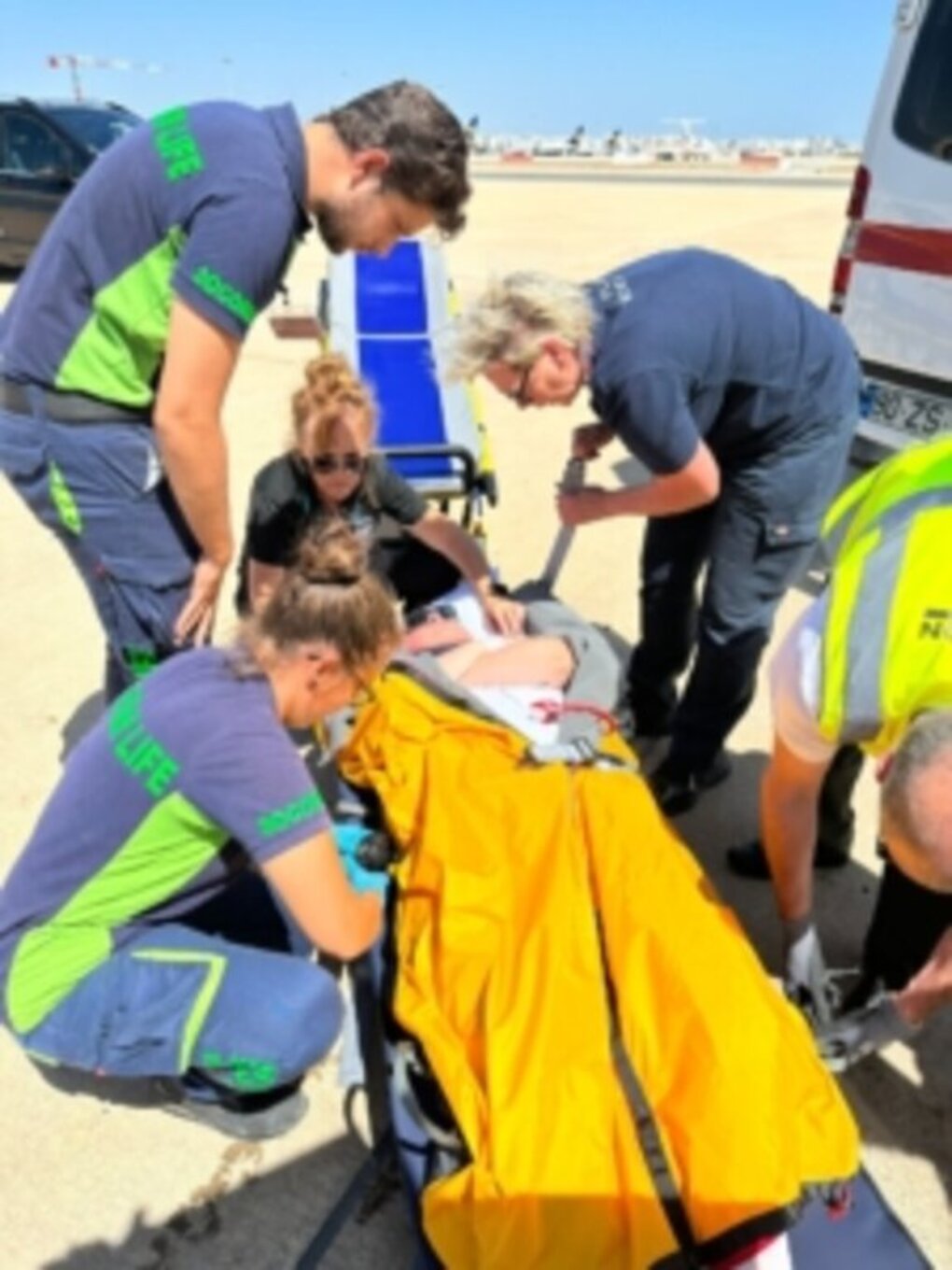
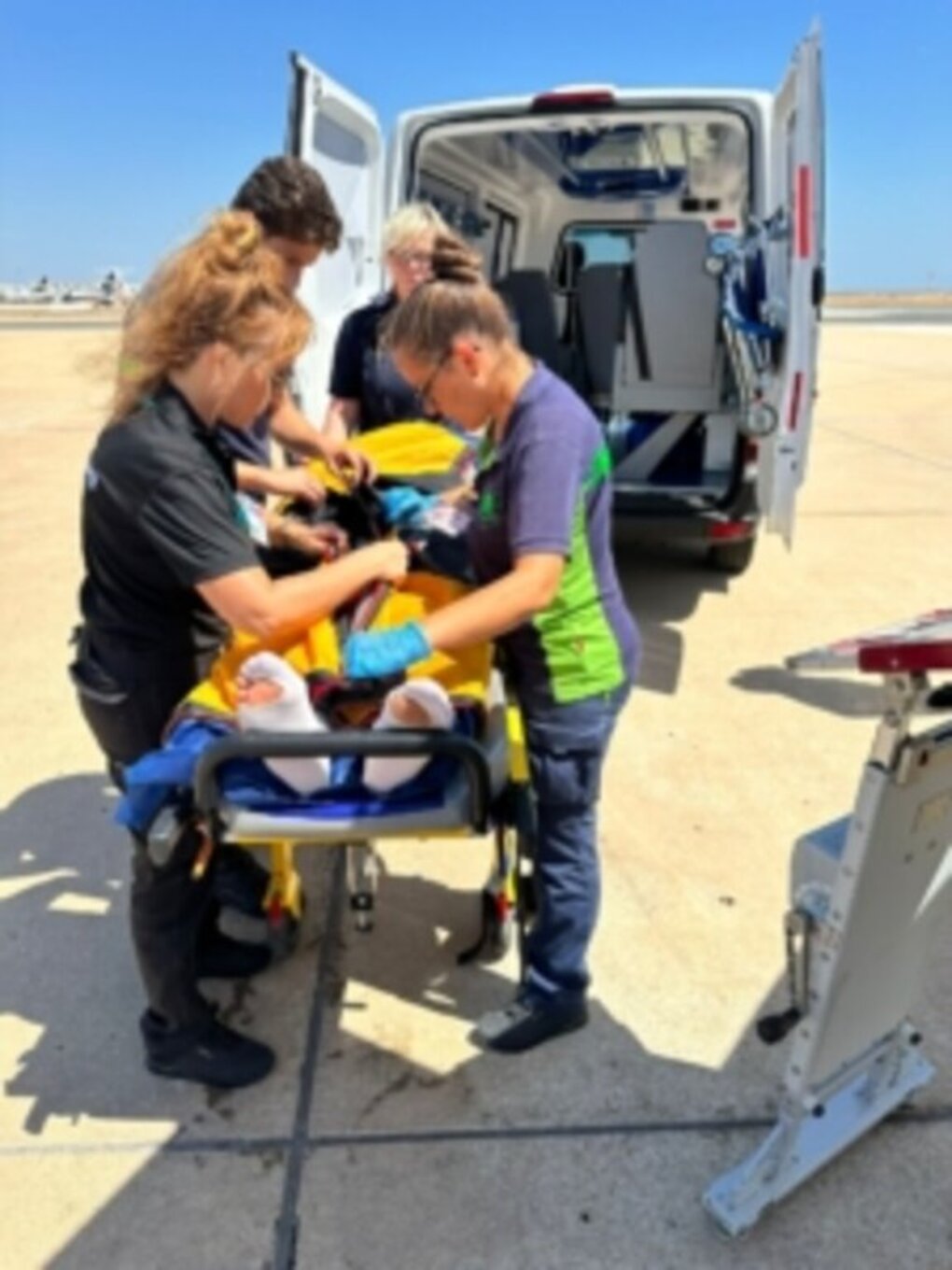
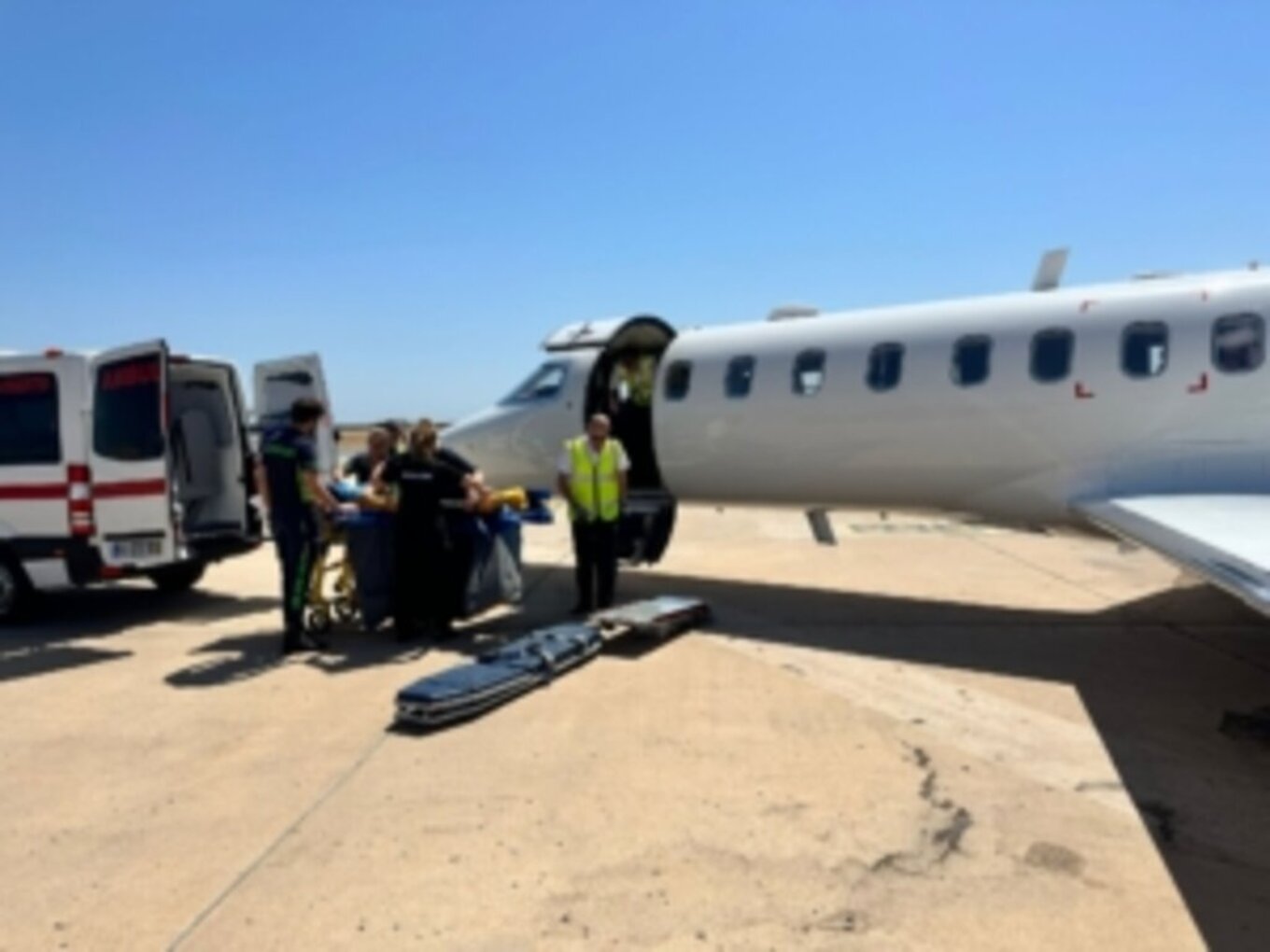
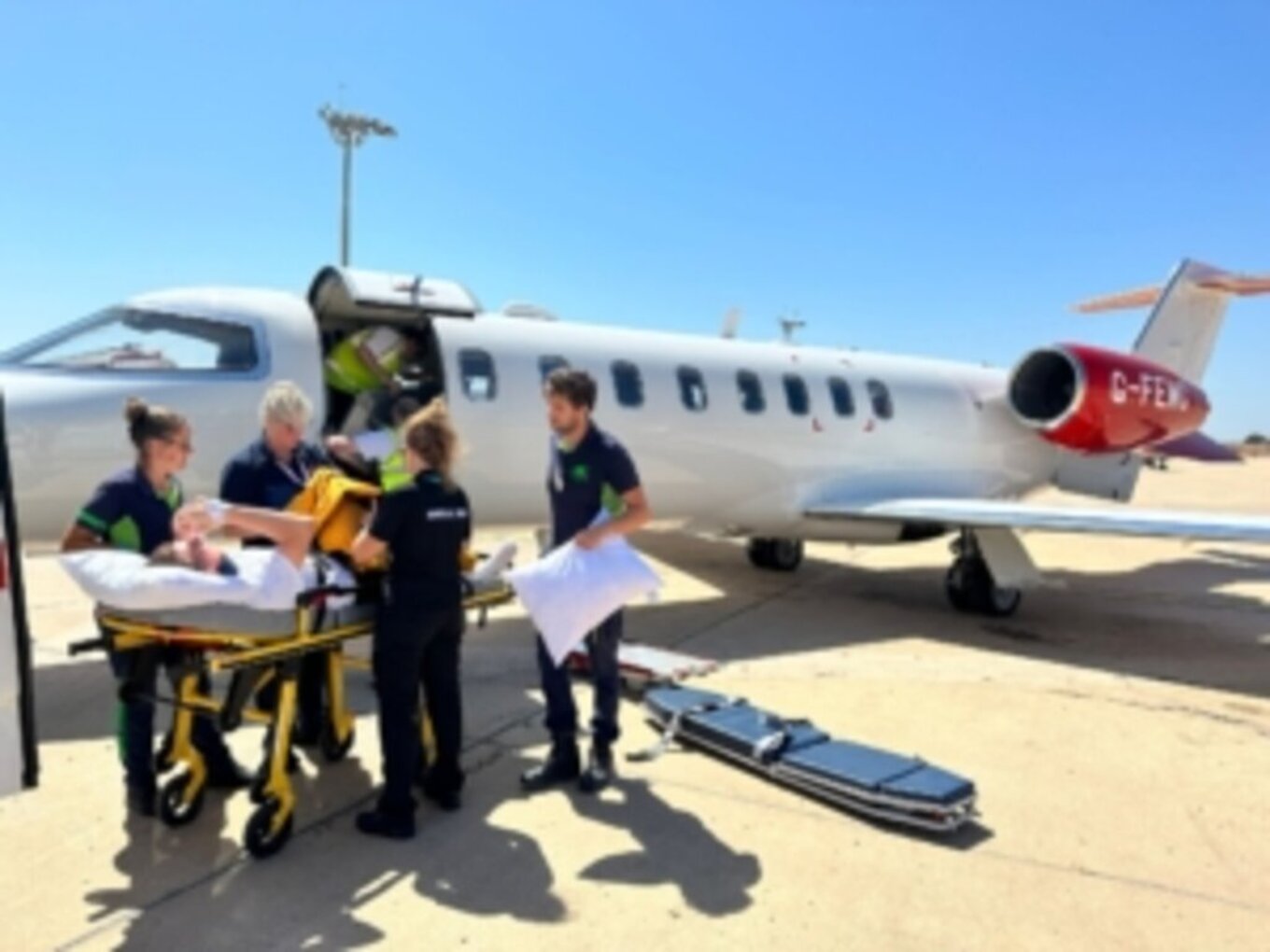
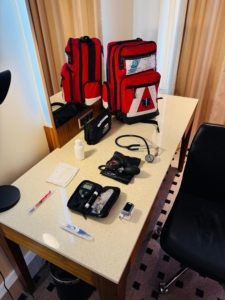
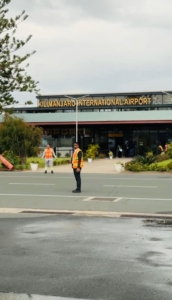
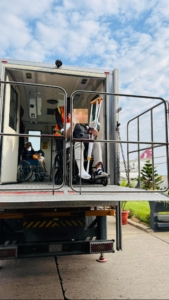
At Aero Medical & Marine Training and Rescue International, we handle diverse and complex missions across the globe, each one with its unique challenges and moments of deep human connection.
One recent mission took us to Kilimanjaro, Tanzania, where a patient sustained serious injuries after a fall during a safari expedition. Thanks to the incredible expertise and dedication of Alexia Hartmann Fernández, who traveled from Spain to personally lead the repatriation, the patient and her family were safely transported to Denmark.
From remote terrain and cross-border coordination to detailed medical planning, this mission was a testament to the resilience of our team and the strength of collaboration. Every procedure, every detail, every mile handled with care, precision, and compassion.
This is just one of many stories that remind us why we do what we do.